Five Awesome Great Lakes Wine Grapes California Wine Snobs Have Never Heard Of
Five grape varietals worth tasting that California wine snobs might miss if they ignore Great Lakes wines: a red bred in Minnesota and named for a Jesuit who mapped the upper Great Lakes, an aromatic white from Cornell that became Indiana’s signature wine, a 19th-century American native that the eastern US wine industry was built on (alongside its cousin Concord) before vinifera arrived, a French hybrid that found its second life as the workhorse of Canadian ice wine, and a Mid-Atlantic favorite that’s quietly working its way inland. They share one thing: each was bred or adopted for reasons California’s wine industry never had to solve for. The Great Lakes region drinks them more than any other corner of the country, and Berrien County is increasingly pouring all five.
Marquette: The Cold-Hardy Red From the University of Minnesota
Marquette was released by the University of Minnesota’s grape-breeding program in 2006, the result of a 1989 cross between two hybrid parents (MN1094 and Ravat 262). The name nods to Père Marquette, the 17th-century Jesuit who mapped the upper Great Lakes and lent his name to a Michigan city, a river, and most of the U.P. coast. Pinot Noir shows up as a grandparent on one side of the family tree, which is where the wine gets some of its flavor character. The other side carries a complicated mix of Vitis riparia and other cold-hardy native species, which is where it gets its survival. Marquette handles winter temperatures down to -35°F. A Cabernet vine in that kind of cold dies in its first January.
The wine drinks like a lighter-bodied Pinot Noir cousin: tart cherry, modest tannins, bright acidity, and a finish that runs more savory than fruity. The Tip of the Mitt AVA has the largest concentration of Marquette growers in the state, and the Petoskey Wine Region has effectively claimed Marquette as its signature red. Mackinaw Trail Winery, Boyne Valley Vineyards, and Walloon Lake Winery all produce single-varietal Marquette worth seeking out; Walloon Lake’s took Best Dry Red at the state wine competition in recent years. Outside the region, Parley Lake Winery (Minnesota), Hop Hill Vineyards (Wisconsin), and Lincoln Peak Vineyard (Vermont) all make distinctive versions at $20-30 a bottle.
Marquette also buds three different times in the spring (a kind of insurance policy against late frost). Lose one set of buds to a cold snap and the vine pushes another. That trait is rare in wine grapes and useful in any region that gets unpredictable shoulder seasons.
Traminette: Indiana’s Aromatic White
Traminette is a cross between Gewürztraminer (the aromatic German white) and a French-American hybrid, developed at Cornell University and released in 1996. Indiana has adopted it as the state’s signature white wine, and most of the country’s commercial Traminette acreage sits in the eastern US between New York and Indiana, with steady production along the Lake Michigan Shore AVA too.
The aromatic profile leans closer to Gewürztraminer than its parent: rose petal, lychee, white pepper, honey on the finish. Most producers make it off-dry, which is what you’ll find at tasting rooms. It pairs unusually well with spicy food (Thai, Indian, Korean), since the residual sweetness offsets capsaicin in a way that dry whites don’t.
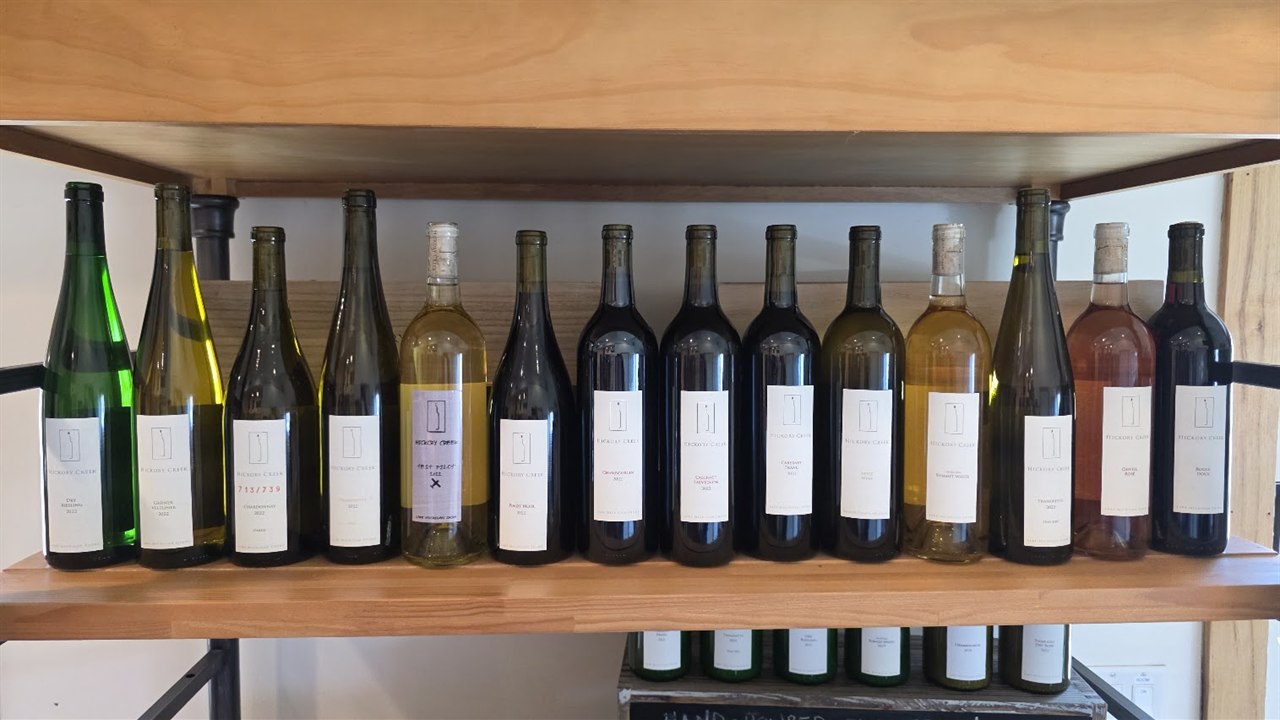
Producers worth knowing: Oliver Winery (Indiana, one of the country’s largest Traminette producers), Lakewood Vineyards (Finger Lakes), Glenora Wine Cellars (Finger Lakes), and across SW Michigan, White Pine Winery (a regular award-winner with theirs), Hickory Creek Winery (whose Traminette sits on the shelf in the photo above), Round Barn, and Tabor Hill. Bottle prices run $15-22.
Niagara: The Grape That Built Michigan’s Wine Industry
Niagara is a Vitis labrusca grape, a North American native bred in Niagara County, New York in 1868 by Claudius L. Hoag and Benjamin W. Clark, who crossed Concord with a white labrusca called Cassady. The grape went commercial in 1882 and immediately found a home across the eastern US: the Great Lakes shore, the Finger Lakes, the Midwest. By the time Prohibition rolled in, Niagara was already one of the most-planted wine grapes east of California, alongside Concord, Catawba, and Delaware in the broader labrusca family that the eastern wine industry was built on.
In Michigan, Niagara is the grape the commercial wine industry was built on. The state still has roughly 3,250 acres of Niagara planted, second only to its cousin Concord. St. Julian Winery, founded by Mariano Meconi in 1921 (originally Windsor, Ontario; in Paw Paw since 1936), is the state’s oldest and most-awarded winery, and its bestselling wines have been Niagara-based for nearly a century. Sweet Niagara has underwritten more Lake Michigan Shore AVA capital investment than any other grape grown here. That dynamic only started shifting in 1971, when Tabor Hill opened in Berrien County as the state’s first winery to specialize in vinifera.
The wine drinks differently than vinifera. Labrusca grapes produce methyl anthranilate, an aromatic compound vinifera doesn’t make: the “foxy” or “Concord grape” character that wine critics have spent 150 years writing off. Taste a Niagara wine and you may immediately think of Welch’s grape juice (Welch’s is built on Concord, Niagara’s cousin, which is not coincidence), or you may think of summer porches and picnic food. Producers worth knowing: St. Julian Winery (Paw Paw, the Niagara flagship for the entire region), Warner Vineyards (also Paw Paw), and most regional wineries pour at least one Niagara wine in their tasting flight. Bottle prices run $10-18, the cheapest serious wines in the state, and the volume sales are part of how Lake Michigan Shore wineries stayed solvent long enough to experiment with the grapes that followed.
Vidal Blanc: The Ice Wine Workhorse
Vidal Blanc has the most surprising origin story of any grape in this article. French breeder Jean Louis Vidal crossed Trebbiano (Ugni Blanc) with a hybrid called Rayon d’Or in the 1930s, trying to develop a grape suited for cognac production in the Charente-Maritime region of western France. He succeeded, and then his grape took a hard left turn into history.
Canadian growers picked up Vidal in the 1970s for its hardy winter survival and tough skins, traits that mattered less for cognac and more for ice wine. Vidal’s grapes can stay on the vine into December and January without splitting, which is exactly what ice wine production requires. You press the grapes frozen, concentrating sugars and acids in the juice. Canada built a major ice-wine industry on the back of this hybrid. Inniskillin Wines in Niagara is the most internationally recognized Vidal ice wine producer, and Finger Lakes and Northern Michigan growers make Vidal ice wines in cold years when winters cooperate. (Black Star Farms on Leelanau is the region’s best-known ice wine producer, though their flagship A Capella is Riesling-based rather than Vidal.)
Outside ice wine, Vidal makes a competent dry to off-dry white that shows up regularly across SW Michigan tasting rooms: clean, lemony, mineral, food-friendly. Most North American Vidal still wines run $15-25; the ice wines are pricier ($30-60 for a 375ml bottle) because of the labor-intensive frozen harvest.
Chambourcin: The Mid-Atlantic Red Coming North
Chambourcin is a French-American hybrid bred in mid-20th-century France by Joannes Seyve, a prolific breeder whose name shows up across the non-vinifera world. The wine drinks lighter than a Cabernet but darker than a Pinot Noir, which puts it in roughly the same body class as a Beaujolais: dark fruit, soft tannins, modest alcohol, food-friendly. Producers also use it for rosé and the occasional dessert wine depending on harvest timing.
Chambourcin’s stronghold has been the mid-Atlantic for decades: Virginia, Pennsylvania, Maryland, New Jersey, and Ohio all built parts of their wine industries on it. The grape handles humidity and disease pressure that would devastate vinifera in those states, and the wine sells well at the tasting-room level because it’s familiar enough to drink like a red but distinctive enough to remember.
What’s changed in the last few years is the inland adoption. Chambourcin acreage across SW Michigan has grown substantially, and I’m seeing it more and more on Berrien County tasting room flights. Hickory Creek Winery in Buchanan (a small operation a few miles inland from Lake Michigan) pours one, and tasting it there made the mid-Atlantic case for the grape land in a way no explanation does. Domaine Berrien Cellars, Baroda Founders Wine Cellar, and other Berrien County producers also pour Chambourcin (sometimes as a single-varietal red, sometimes blended into the bigger Bordeaux-style reds the region keeps experimenting with). The lake-effect climate that built Northern Michigan Riesling is doing similar work down on the southern shore.
How To Try All Five
The cheapest way to learn what wine looks like outside the California vinifera canon is a five-bottle flight at home, one of each. Marquette, Traminette, Niagara, Vidal Blanc, and Chambourcin will run you $80-110 total (Niagara is the bargain of the bunch), and together they cover Midwest red, aromatic white, Michigan heritage white, ice-wine workhorse, and food-friendly mid-Atlantic red. Four of the five are pouring in Berrien County tasting rooms right now. Buy them, taste them blind on a Saturday afternoon, and look at the labels after. You’ll have just sampled five grapes the California canon doesn’t cover.
If you’re already planning a tasting-room weekend across any of the four Michigan AVAs, ask for the hybrid and heritage flight. Most serious tasting rooms pour at least three of these five. Walk in with curiosity, not expertise. These wines don’t need a quiz at the door, and the wineries pouring them want to talk about why their geography grows what it grows. Hickory Creek is a good starting point if you’re in Berrien County; St. Julian in Paw Paw for the Niagara heritage; Mackinaw Trail or Boyne Valley if you’re closer to the Tip of the Mitt; Chateau Grand Traverse on Old Mission for Riesling-and-Vidal-ice-wine country.